

Contemplations, Vol. 07
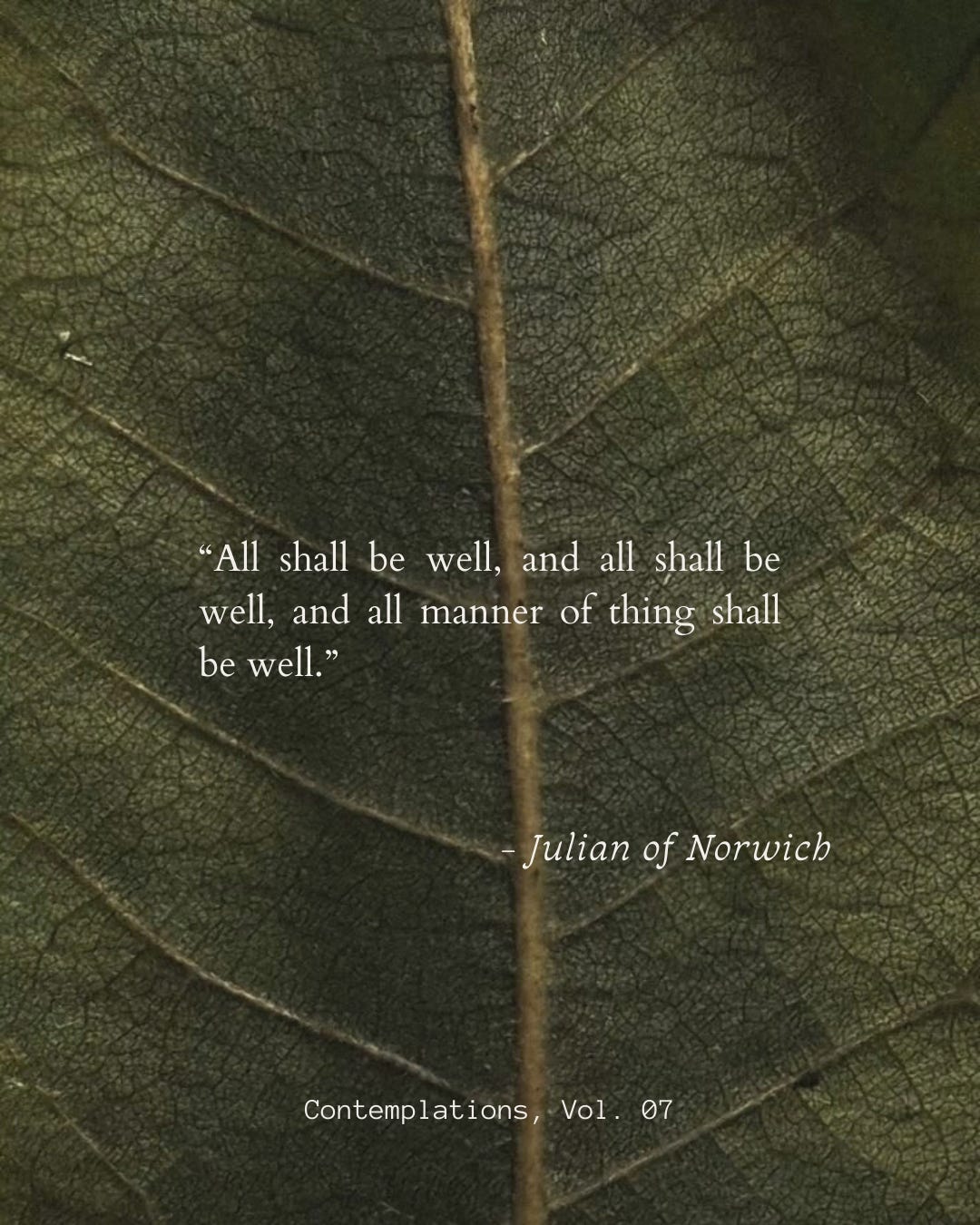
All shall be well with Julian of Norwich

February’s Contemplation almost didn’t happen, but I’m squeezing it in just in the nick of time.
It’s been a busy month… to say the least.
From politics to our personal lives, everything feels both intense and delicate right now. There continues to be so much uncertainty, and it only seems to be ramping up.
If there’s one thing I know, life is uncertain.
Even when things feel calm, life is simply uncertain. God’s plan is beyond our grasp and it’s part of the mystery of this existence.
However, uncertainty has a way of pulling us into fear, and with so much fear looming, I wanted to share a quote by Julian of Norwich — a Christian Mystic who I became enamored with a few years ago.
Julian, sometimes called Juliana — whose real name remains unknown along with most details about her personal life — was a woman living in England in the 1300’s. She was what the Catholic Church called an anchoress, living in permanent seclusion in a little “cell” attached to her church.
Being an anchoress or anchorite was a fascinating role. They had to go through a religious rite of consecration (which resembled a funeral), after which they would be considered dead to the world and a type of living saint. Wild!
While she did live in seclusion, Julian also served her community by offering spiritual guidance through a little window in her cell — she was highly sought after. If the window was open, locals could come confide in her, if it was closed, she was in prayer.
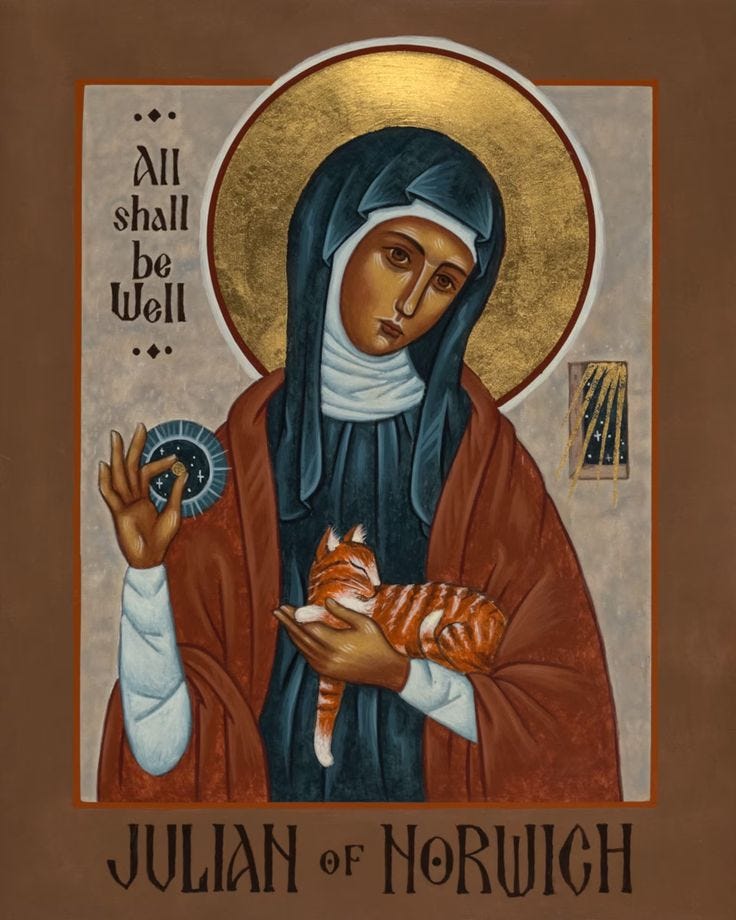
Fun fact: being secluded from the outside world, the only creature allowed in her cell was her cat — she’s considered the OG cat lady by some (I love her for this) — in fact, she is often depicted in paintings holding a cat. (see bottom of article)
In 2022, while living in England, I drove across the country to Norwich to visit her cell, as I wished to understand more about her and her living conditions.
Julian lived through several monumental times in history, including the Black Death. Some researchers and theologians believe she may have even been a wife and mother, potentially losing her family to the plague.
At the age of 30, Julian became incredibly ill and was on her deathbed. While receiving her last rites from the Priest, she had 16 visions of the Passion of Christ that would change her life.
Astonishingly, she recovered and went on to write about what it was she saw.
Julian ended up writing Revelations of Divine Love — famous for being the earliest surviving book in English known to have been written by a woman.
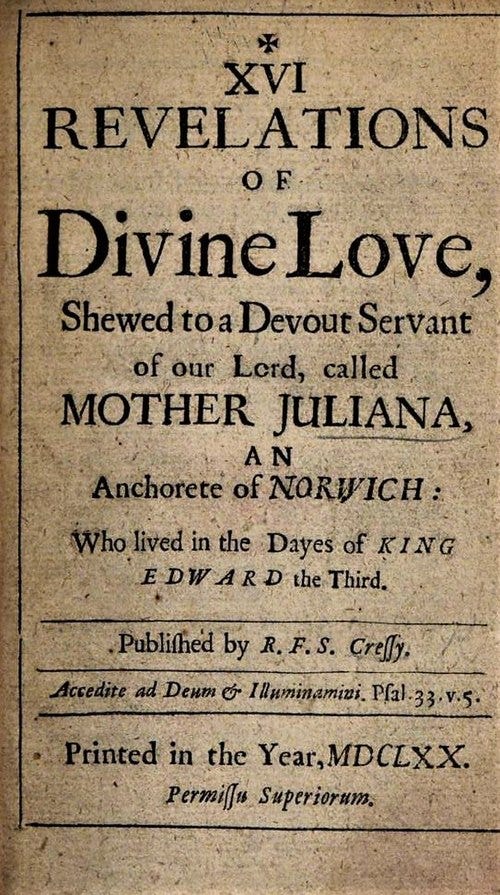
In her writings, she uses maternal imagery for God, referring to “Jesus as our Mother” and nursing from the breast of Jesus — not to infer that Jesus was feminine, but that his Love for us is like that of a mothers for her child. She is describing Christ’s Love, sacrifice, and nourishment in maternal terms.
“All shall be well” is Julian’s most famous quote from Revelations of Divine Love, but I want to give it full context:
He said not: “Thou shalt not be tempested, thou shalt not be travailed, thou shalt not be dis-eased”;
but he said: “Thou shalt not be overcome.”God wills that we take heed to these words, and that we be ever strong in sure trust, both in weal and in woe.
And all shall be well, and all shall be well, and all manner of thing shall be well.
Essentially what Julian is saying is: God does not promise that we will not experience suffering, but He does promise that we will not be overcome by it. We must trust that all things shall be well in Christ’s love.
Regardless of your religious beliefs — in a world that feels so uncertain, can we have unwavering faith that all will be well? That we can trust what is unknown? Can we have certainty in the uncertainty of life?
I’m sure trying.
Sending you a big hug.
Love & Prayers,
Kelly
This was beautiful, thank you! Wonderful to learn about a new-to-me-mystic too.
Very timely. Thank you 🙏